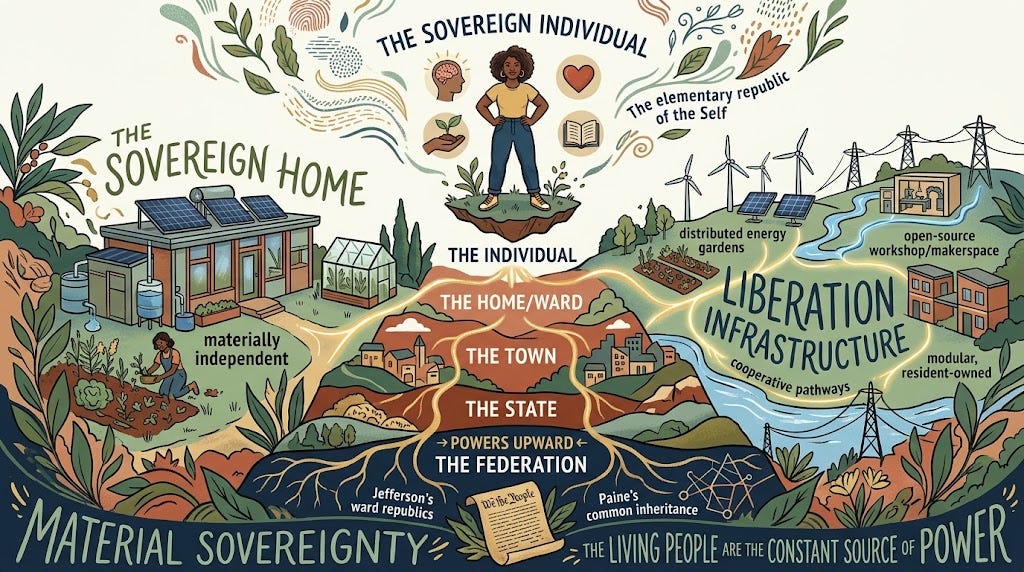
by Brandon King
I. Where Authority Begins
A Sovereign Citizen is a person who possesses ultimate authority over themselves. That authority includes the body, mind, conscience, identity, home, time, voluntary associations, personal information, possessions, and direction of one’s own life. It extends until its exercise infringes the equal sovereignty of another person.
Where does legitimate political authority begin? The American answer begins with the people. The Constitution opens with “We the People.” The federal government receives powers through the Constitution. States retain broad authority of their own. People possess rights that neither may simply set aside.
The Ninth and Tenth Amendments add something important. The Ninth says that naming certain rights in the Constitution cannot be used to deny or disparage others “retained by the people.” The Tenth says that powers neither delegated to the United States nor prohibited to the states are reserved “to the States respectively, or to the people.” I read them as two sides of the same constitutional coin. The Ninth concerns rights retained by the people. The Tenth concerns powers reserved to the people.
The final words of the Tenth do not say that every power withheld from the federal government belongs to the states. Those powers are reserved to the states respectively, or to the people. Modern Tenth Amendment doctrine has developed mainly around federalism and the limits of federal power over the states. I read the text more broadly. Some authority was never delegated upward at all.
The ratification debates raised the same question. Writing as An Old Whig in 1787, one Anti-Federalist argued that people entering political society should surrender only as much liberty as government needed and “retain all beyond what is necessary.” In his next essay, he treated liberty of conscience as belonging so firmly to the person that people did not even have the right to surrender it.
II. The Smallest Republic
How much authority does government actually need? Some matters require national action. Others belong to states, towns, neighborhoods, or households. Reaching the smallest government on the map does not mean we have reached the smallest place where authority can rest. Some matters require no government jurisdiction at all. They belong to the individual.
Thomas Jefferson approached the same problem through his proposal for ward republics. In an 1816 letter to Joseph C. Cabell, he argued that government should be divided according to what each level was capable of handling. National affairs belonged to the national government, state affairs to the states, county affairs to counties, and neighborhood concerns to wards. He carried that division all the way down to “the administration of every man’s farm by himself” and argued that the individual should remain the depository of the powers concerning himself, delegating upward only what exceeded his own competence.
Later that year, writing to Samuel Kercheval, Jefferson called the wards “pure and elementary republics.” Politically, the ward was his smallest republic. Materially, responsibility reached all the way to the farm. What is the elementary republic beneath the elementary republic? The self. The individual is the proper authority over matters that concern only that individual.
This is close to subsidiarity, but the question comes earlier. Before deciding which institution should exercise a power, ask whether an institution needs that power at all. Shared problems require shared decisions. Personal matters do not become public merely because a public authority exists.
III. The Inheritance of the Living
Jefferson carried the same concern across generations. Writing to James Madison in 1789, he began from what he called a self-evident principle, “that the earth belongs in usufruct to the living.” The dead, he argued, no longer possessed rights over it. Using the mortality figures available to him, he settled on roughly nineteen years as the life of a generation and argued that constitutions and laws should not bind succeeding generations indefinitely.
Jefferson later rejected both constant experimentation and the tendency to regard old constitutions with “sanctimonious reverence.” Laws and institutions, he argued, had to advance as knowledge grew and circumstances changed. Paine likewise insisted that every generation remained equal in rights to those before it. The Constitution itself provides for amendment. The republic is an inheritance to be maintained and improved by the living, not a completed order to be preserved unchanged.
Generational sovereignty does not give the living a legitimate power to make one another subjects. Political authority still comes from people who possess equal sovereignty of their own. What each generation inherits is the authority to continue the work. The people are not merely the original source of political authority. The living people remain its constant source.
IV. Somewhere to Stand
The old American republic held up the independent yeoman farmer as an ideal citizen. Jefferson praised cultivators of the earth as unusually independent and tied their position to the liberty of the country. The point was not simply that farming was virtuous. A smallholder who possessed land, shelter, tools, and productive capacity had some material independence from employers, landlords, creditors, and patrons who might otherwise control the terms of daily life.
That independence had political consequences. A person who could feed a household, remain housed, and preserve some control over their livelihood had greater room to speak and vote according to conscience. Small farmers were never fully insulated from markets or debt, but self-sufficiency reduced the number of people who could credibly threaten a citizen’s survival for taking the wrong side in public life.
The farm mattered because it gave a person somewhere to stand. Land, shelter, productive capacity, and some control over the terms of life made it easier to appear in public as a citizen rather than a dependent. The farm itself is not the part worth recovering. The independence is.
Thomas Paine approached the problem differently. In Common Sense, Paine attacked monarchy and hereditary succession and made the case for a republic grounded in people rather than inherited rule. Years later, in Agrarian Justice, he argued that the earth in its uncultivated state was the common inheritance of humanity and proposed a national fund that would give every person a payment upon reaching adulthood and an annual payment later in life. He insisted that he was arguing for a right rather than charity.
Jefferson and Paine offered different answers, but both were concerned with the independence of the citizen. A republic asks ordinary people to govern themselves and what they hold in common. That becomes harder when the basic terms of life can be withdrawn at someone else’s discretion. A person can have the vote, freedom of speech, freedom of association, and every other formal mark of citizenship while spending much of life worried about losing a home, a paycheck, healthcare, electricity, transportation, or access to things they already own.
The rights remain technically real, but their use becomes more costly. What kind of material order produces citizens instead of dependents?
For Jefferson, one answer was the yeoman farm. Paine wanted ordinary people to possess a material claim of their own. Our conditions require another answer.
V. From the Farm to Liberation Infrastructure
That is where the Sovereign Home comes from for me. My own path toward it began with Earthship architecture. What drew me to Earthships was the idea that a house could function almost like a self-regulating organism, helping to provide the conditions its inhabitants need to live by managing heat, water, energy, and some food production while reducing dependence on outside inputs.
The principle matters to me beyond one architectural style. Homes, neighborhoods, and eventually whole cities can take on more of the work of sustaining the people who live within them. The built environment should not merely surround human life. It can actively support it, conserve resources, recover from disruption, and provide a meaningful degree of self-sufficiency.
As the technology developed, additive and modular construction, distributed energy, automation, new materials, and open source design gradually replaced the Earthship itself in my thinking. The Sovereign Home began as my own dream home, but cheaper and more customizable construction raised a larger possibility. Highly individualized and increasingly self-sufficient housing did not have to remain an expensive one-off project.
Reducing construction costs, however, does not prevent the finished home from becoming another speculative asset. That pushed the idea toward a public option. Public institutions could build homes at scale, keep acquisition costs tied more closely to the cost of providing them, and move those homes toward resident ownership so that technological savings reached the people living there rather than being absorbed into rents or speculative prices.
The Sovereign Home is my twenty-first-century version of the Jeffersonian yeoman farm. It is designed to cost less to live in and give residents more control over daily life. It can lower energy demand, produce and store power, manage water, support some food production, and remain repairable without permanent dependence on one manufacturer. The public model carries those ideas farther by moving the home toward resident ownership instead of permanent rent.
Sovereign Homes can remain connected to electrical grids, municipal water, roads, schools, hospitals, communications networks, and everything else that makes modern life possible. A free person does not need to live alone. A free person needs enough room to say no. A household with more control over its own needs has more room to leave a bad job, survive an interruption, reject bad terms, or choose another path without putting its livelihood in jeopardy.
I call the larger condition material sovereignty. Material sovereignty is the practical ability to direct one’s own life when the basic conditions of survival are secure. Modern life rests on cooperation. We depend on other people for medicine, utilities, transportation, communications, knowledge, machinery, and countless things no household could sensibly provide for itself.
The important question is what kind of power comes with dependence. A worker may be legally free to quit, but that freedom means something different when losing a paycheck can also mean losing a home or healthcare. Someone may own a machine and still depend on its manufacturer for the parts or software that keep it working. A town may elect its government while having little control over companies that provide systems it cannot function without.
A republic can preserve elections, rights, and public offices while leaving people with little practical independence. Political freedom is harder to exercise when the basic conditions of life can be withdrawn by an employer, landlord, corporation, or other institution with power over access. A person may possess rights in law while having much less room to use them according to conscience.
A citizen needs somewhere to stand. Liberation Infrastructure is my name for the systems that make that independence more durable. Housing, energy, healthcare, transportation, communications, public finance, open source knowledge, and automated production can be organized so that people have greater control over the conditions of everyday life.
The point is not simply to provide more services. It is to use shared infrastructure to reduce the leverage that any single institution can hold over a person’s life. Public housing can become resident ownership. Public finance can help communities build wealth of their own. Distributed energy can give households and neighborhoods greater control over essential resources. Automation can return part of its gains as time rather than only as profit.
The state does not have to disappear before people become more independent of it. Public power can build the conditions under which less public power is needed later. Government is a delegation. Its authority begins where people have reason to act together. When common action solves a shared problem while leaving people with greater command over their own lives, the delegation has served its purpose.
Technology can push that process in either direction. Automation, biotechnology, advanced fabrication, and increasingly autonomous infrastructure can give ordinary people capacities once available only to governments and large corporations. They can also make daily life dependent on systems that people cannot inspect, repair, leave, or govern.
An orbital rotating space habitat makes the distinction unusually clear. Everyone aboard depends on structural integrity, atmospheric composition, water recycling, radiation shielding, thermal control, navigation, and collision avoidance. These systems have to be governed in common because their failure threatens the entire community.
That necessity creates legitimate public authority, but it also defines its limits. The inhabitants have reason to establish common institutions to maintain the habitat, set safety standards, allocate shared resources, and protect systems on which everyone depends. Stewardship of the habitat does not give its government sovereignty over the citizens who created it.
The republic may govern the systems that keep the republic alive. It does not follow that it may govern a person’s conscience, identity, relationships, body, home, or ordinary choices. Liberation Infrastructure can therefore scale from the household to an entire constructed world without changing the underlying principle. Shared necessity creates shared authority where the necessity exists and no farther.
The same principle works on Earth. A town should govern what truly needs to be governed by the town. A state should govern what requires the state. A federation should govern what requires a federation. Power should travel upward only when the problem does.
Everything else stays closer to home. Eventually, home means the person. “We the People” is ultimately made of people. The rights retained and powers reserved to the people are not whatever government happens to leave alone. They mark the boundary between what may be entrusted to common institutions and what remains with the people themselves.
Government may exercise what people delegate for common purposes. Delegation does not give it ownership over the people who delegated it.
At the smallest scale, “the people” resolves into persons. The individual does not receive sovereignty from government. Government receives authority from people who already possess it.
My literal dream
We should do a New Mexico Earthship excursion!