
Friends. Futurists always think we stand at an historic turning point. But today, with the threats to democracy, the rise of the far right, climate crisis, AI existential risks, and a growing gap between ordinary citizens and oligarchs’ wealth and power, the central political question is how to assert democratic control. Will corporate monarchs weaponize the infrastructure of artificial intelligence, biotechnology, and robotics to perfect surveillance and exploitation, and protect inequality? Or will democratic movements reclaim it to build a post-scarcity world of universal human flourishing?
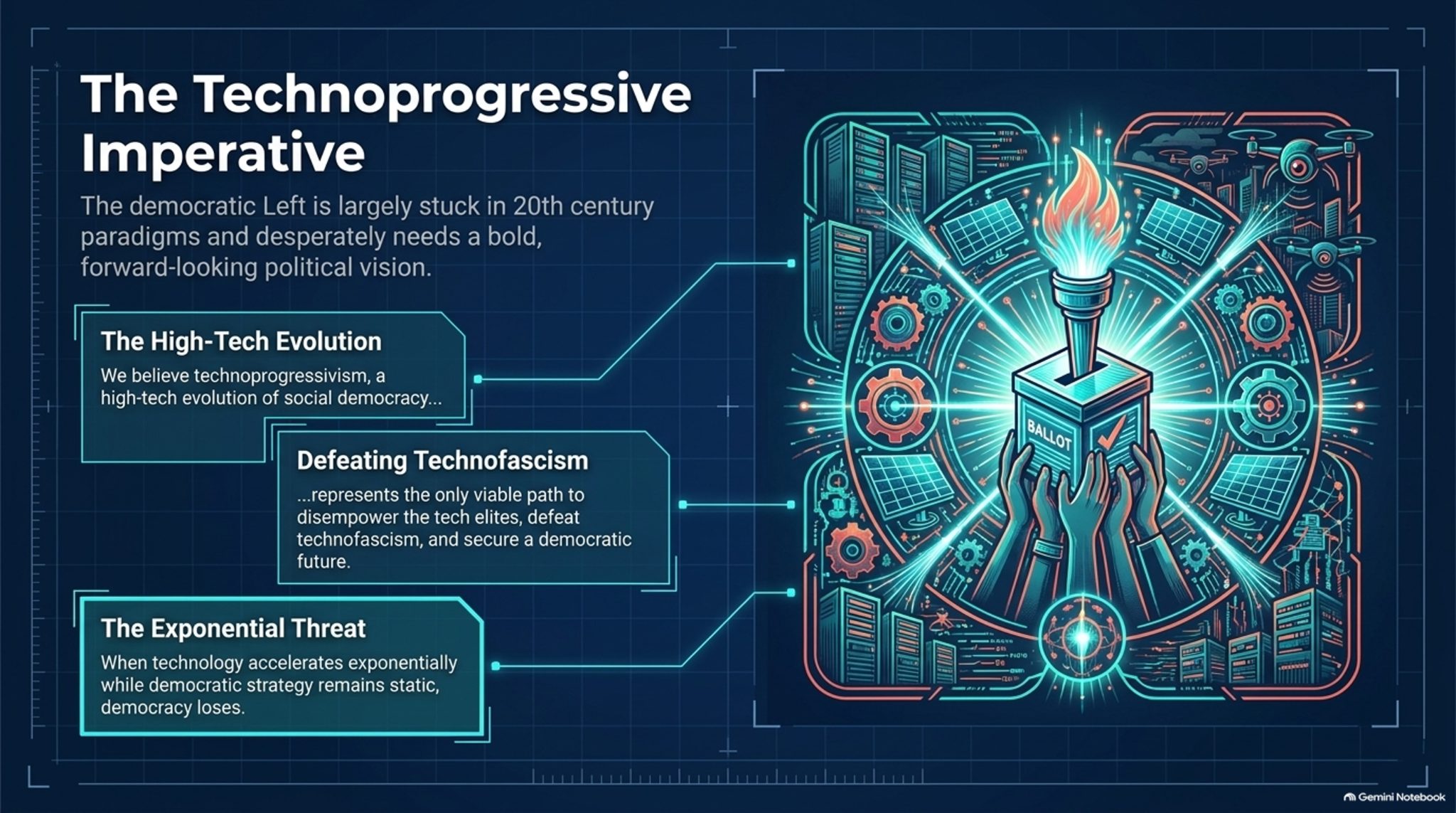
The democratic Left is largely stuck in 20th-century paradigms - full employment, redistribution, or, disastrously, Leninism - and desperately needs a bold, forward-looking political vision. We believe technoprogressivism, a 21st-century evolution of social democracy, represents the only viable path to disempower the tech elites, defeat technofascism, and secure a democratic future. When technology accelerates exponentially while democratic strategy remains static, democracy loses.
We face a new, technologically defined terrain of possibilities, shaped by American, Russian, Chinese, and European models. Libertarian accelerationism governed by tech oligarchs and their far-right kakistocracies. Neo-feudal regimes where the strongmen do away with democracy altogether. State capitalist regimes under the thumb of surveillance. Or the European social democratic model - civil liberties, strong democratic institutions, and checks on corporate power - updated for the 21st century.
Unmasking Silicon Valley Technofascism
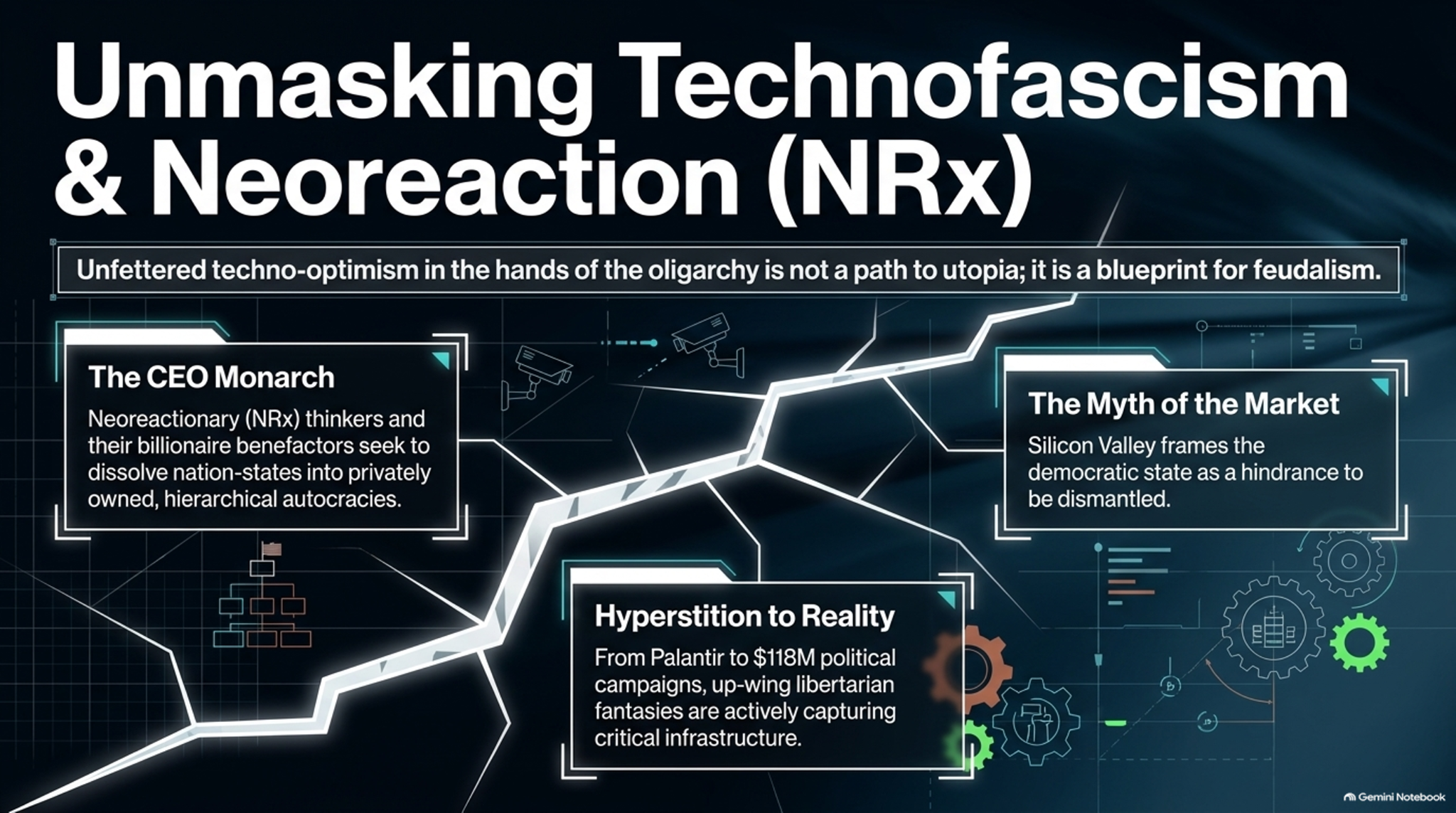
Reclaiming technology is urgent because our opponents are executing a slow coup against democratic governance. Silicon Valley is no longer merely a center of commercial enterprise; it has become the incubator for a new, virulent strain of authoritarianism—technofascism.
Flowing from figures like Peter Thiel, Marc Andreessen, and Elon Musk is an ideology heavily influenced by neoreaction and unregulated market fundamentalism, but now allied with MAGA’s authoritarianism, racism, crony capitalism, and US imperialism. These elites view democracy as an impediment to their capital accumulation. They dream of an “exit” into private corporate autocracies, where unaccountable tech monarchs govern through algorithmic surveillance, micro-targeting, and robot police. They use their platforms to promote far-right authoritarians here in the UK, and around the world.
The Left’s Luddite Trap
Before we can build a high-tech social democracy, we must diagnose the fatal weakness in contemporary progressive strategy. Technophobia on the Left is a recent historical anomaly. Historically, the progressive tradition was defined by a bold, Promethean embrace of science and technology.
The Enlightenment thinkers believed human reason and scientific inquiry would shatter religious dogma, dismantle feudal hierarchies, and liberate humanity from toil and disease. Earlier progressives also understood that human emancipation requires democratizing technology for collective benefit. Only in the post-WWII era—amid nuclear anxieties and postmodern theory—did the Left sever its ties with technological optimism.
Technoprogressivism reclaims our Enlightenment, reuniting optimism about individual liberty and democratic self-determination with optimism about reason, science, and technology. Scientific knowledge and technical innovation are the cumulative products of centuries of collective human labor. Their fruits belong to the 99%, and our task is not to smash the machine, but to democratize it.
By adopting technophobia, the Left cedes the entire terrain of the future to Silicon Valley billionaires. When we tell working-class communities that the future offers only reduced consumption and technological stagnation. At the same time, reactionary oligarchs promise infinite energy, superintelligence, and radical longevity, we hand our opponents an ideological monopoly over hope. We cannot defeat billionaire accelerationism by advocating for stagnation; we must defeat it by fighting for democratized abundance.
Progress is Not Inevitable; It Must Be Democratically Steered
To defeat technofascism, we must understand how it operates. Technofascism does not rely solely on traditional state violence, although the techno-authoritarians are preparing to use violence. More subtly, their project operates through the embedded rules of digital architecture. Platform capitalism extracts public data, exploits digital labor, and uses proprietary algorithms to divide communities and subvert citizen agency. Oligarchs’ concentrated ownership of media outlets cements their control over the public narrative.
Technoprogressives insist that technology itself is not inherently authoritarian. The surveillance capitalism we experience today stems from corporate ownership, monopolies, and authoritarian architecture. The same technical tools—cybernetics, predictive modeling, AI, and robotics—can be redesigned to build a transparent architecture of democratic governance.
This brings us to the core thesis of technoprogressivism: reuniting social and technological progress and accepting responsibility for emerging technological opportunities to steer away from dystopia and toward utopia.
Technoprogressives are unapologetically techno-optimistic about human potential, but we reject the dangerous lie of market accelerationism—the claim that profit-driven technological progress is inherently self-correcting or automatically beneficial. Technological change is not an autonomous force of nature, but it shapes the terrain of political struggle.
Without democratic mobilization and regulation, technological innovation inevitably concentrates power, exacerbates inequality, and risks catastrophic harms. Our principle is simple: emerging technologies must be subordinated to democratic accountability, and their benefits must be universally shared as public goods.
Building the 21st-century Technoprogressive Stack
The Technoprogressive Stack is a 21st-century framework for social democracy, organizing the state’s high-tech political agenda into a cohesive four-tier pyramid. Functioning as a structural operating system for abundance, the stack builds sequentially from foundational computational infrastructure up to individual self-determination, ensuring that rapid technological change is democratically steered toward universal human emancipation.
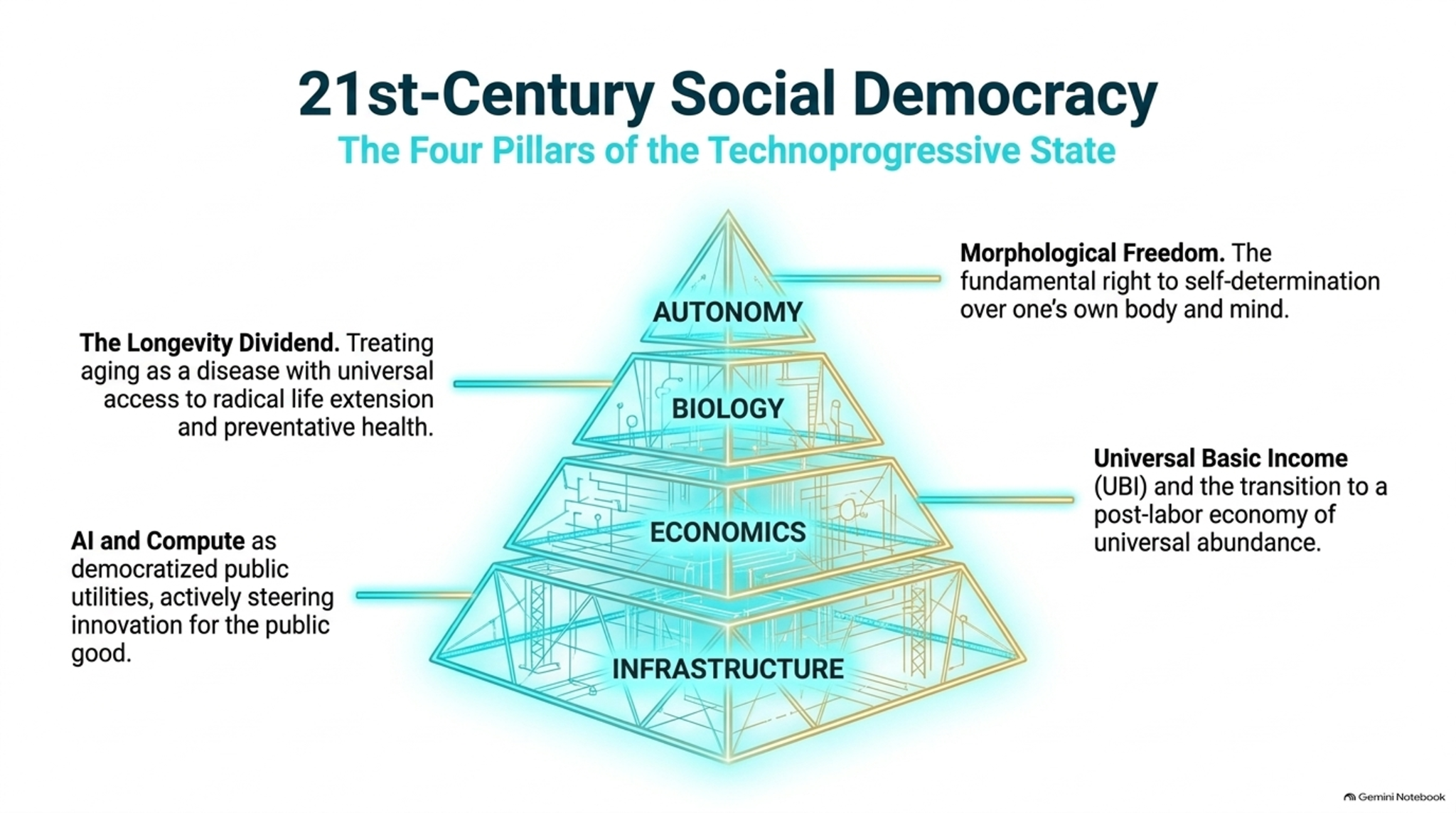
At the base is Infrastructure, AI, and Compute as democratized public utilities. Rather than letting private tech oligarchs capture foundational algorithms, massive data centers, and advanced computational power, we can assert public oversight and digital sovereignty, actively steering technological innovation toward public goods and societal needs.
Above infrastructure lies Economics, centered on Universal Basic Income (UBI) and services, and the transition to a post-labor economy of universal abundance. By socializing the immense productivity gains generated by AI and robotics, this layer severs basic human survival from wage labor, using tech-driven wealth to guarantee economic security, healthcare, and lifelong education for all citizens.
Biology introduces The Longevity Dividend. By treating biological aging as a treatable medical condition and ensuring universal access to life extension therapies, geroscience, and preventative healthcare, this tier guarantees that health breakthroughs benefit everyone equally rather than creating a dystopian biological class divide.
At the apex is the promise of expanded personal Autonomy, one aspect of which is Morphological Freedom, our fundamental right to self-determination over our own body and mind. This pillar secures individual liberty regarding consensual biomedical modifications, reproductive choice, gender affirmation, and cognitive self-direction against state coercion and religious dogma.
How do we operationalize this framework? We start by dismantling Big Tech’s private monopolies over foundational technical infrastructure.
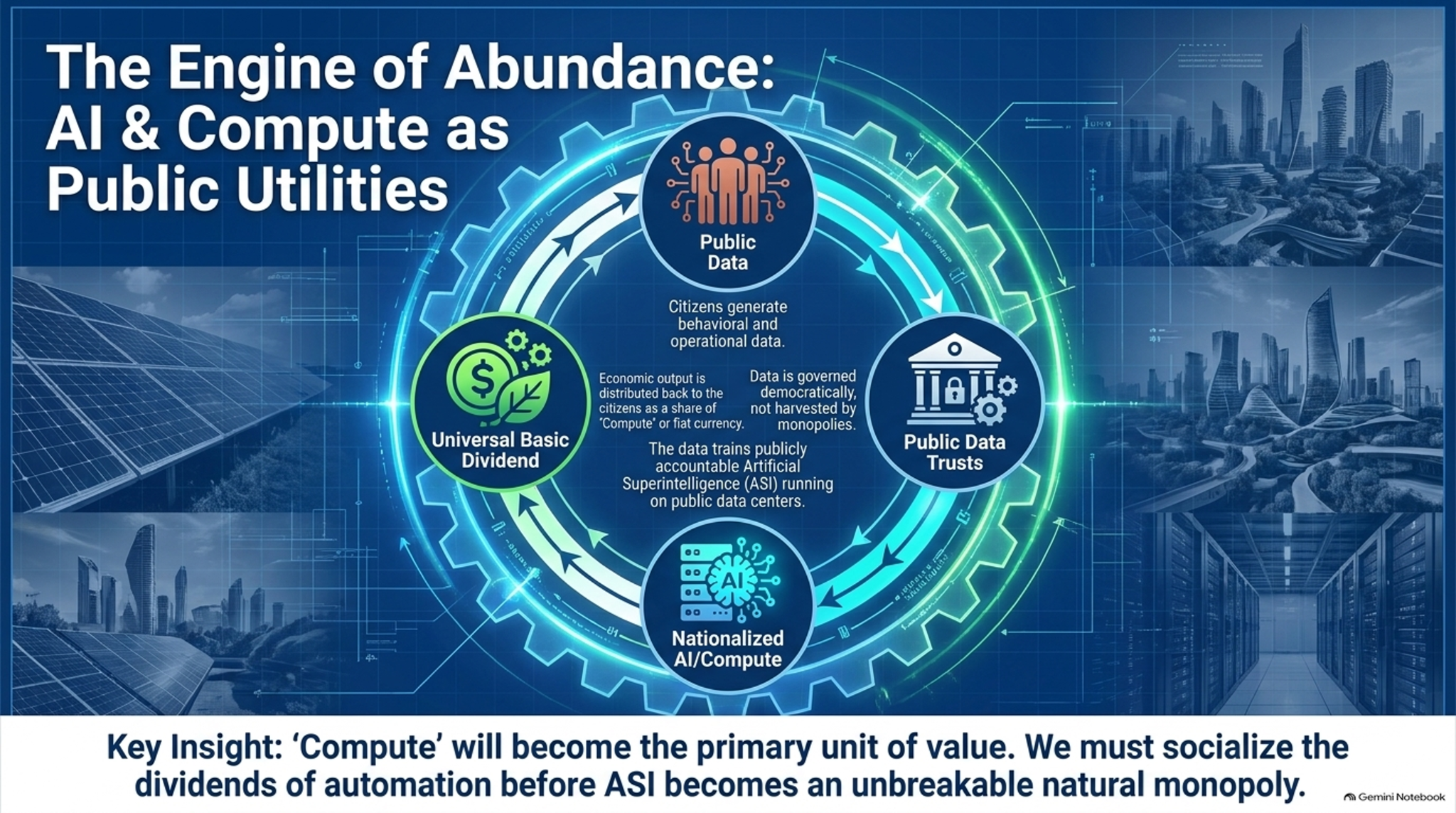
Today, foundational AI models and massive data centers are in proprietary silos. Private firms dictate the direction and extract rents from the public. Technoprogressives demand that compute, foundational AI, and digital networks be treated as public utilities.
Public Data Trusts & Digital Sovereignty
We advocate for public equity stakes in AI corporations whose models were trained on publicly generated data. We support creating public data trusts and state-funded open-source AI infrastructure. By establishing digital sovereignty, states can ensure that tech is deployed to solve climate crises, optimize public transport, and streamline public services rather than generate engagement-driven corporate profits.
Citizens’ data generated within a city or nation should be managed by independent public trusts, not private corporations. Public data trusts can mandate strict privacy protections while allowing public researchers and businesses to access anonymized data for public benefit—such as optimizing traffic, improving public healthcare, or training localized models. Digital sovereignty ensures that the wealth generated by public data returns to the public.
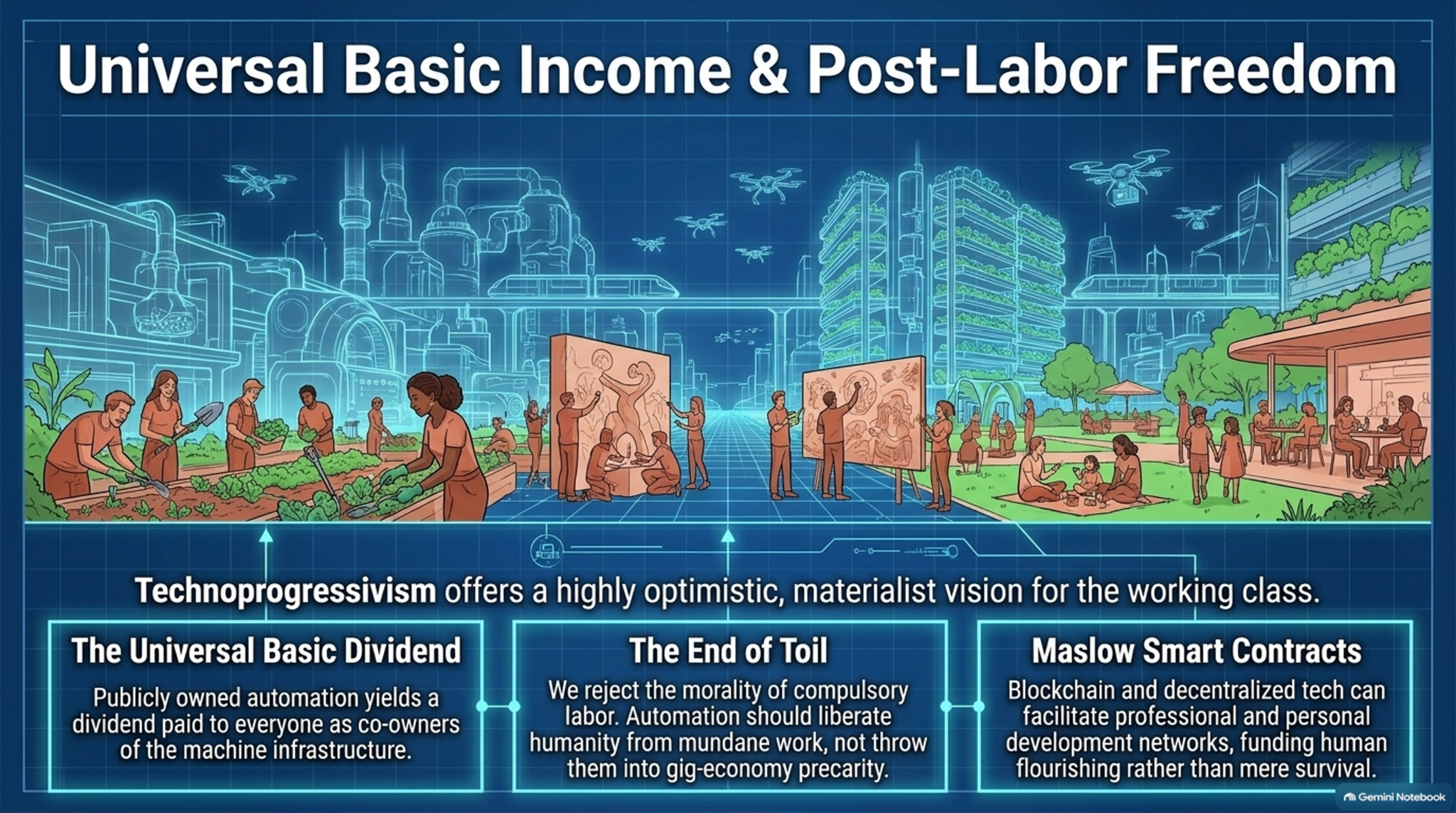
Universal Basic Income & Post-Labor Liberation
UBI addresses the transformation of labor. Automation and artificial intelligence are on the cusp of displacing routine cognitive and physical work. The conservative and centrist response is to deny this displacement while displaced workers land in precarious gig work and underemployment.
Technoprogressives embrace automation as a liberating force, but we must redistribute the gains. We do not fight to preserve backbreaking or boring jobs for the sake of full employment. Instead, we advocate for a robust Universal Basic Income (UBI), paired with Universal Basic Services—healthcare, housing, and lifelong education.
UBI and universal services can be funded through progressive taxation on automated capital and tech-driven wealth. By strengthening the welfare state, we can transform the threat of automated precarity into a guarantee of post-labor freedom, granting every citizen the security to pursue creative, political, and personal fulfillment.
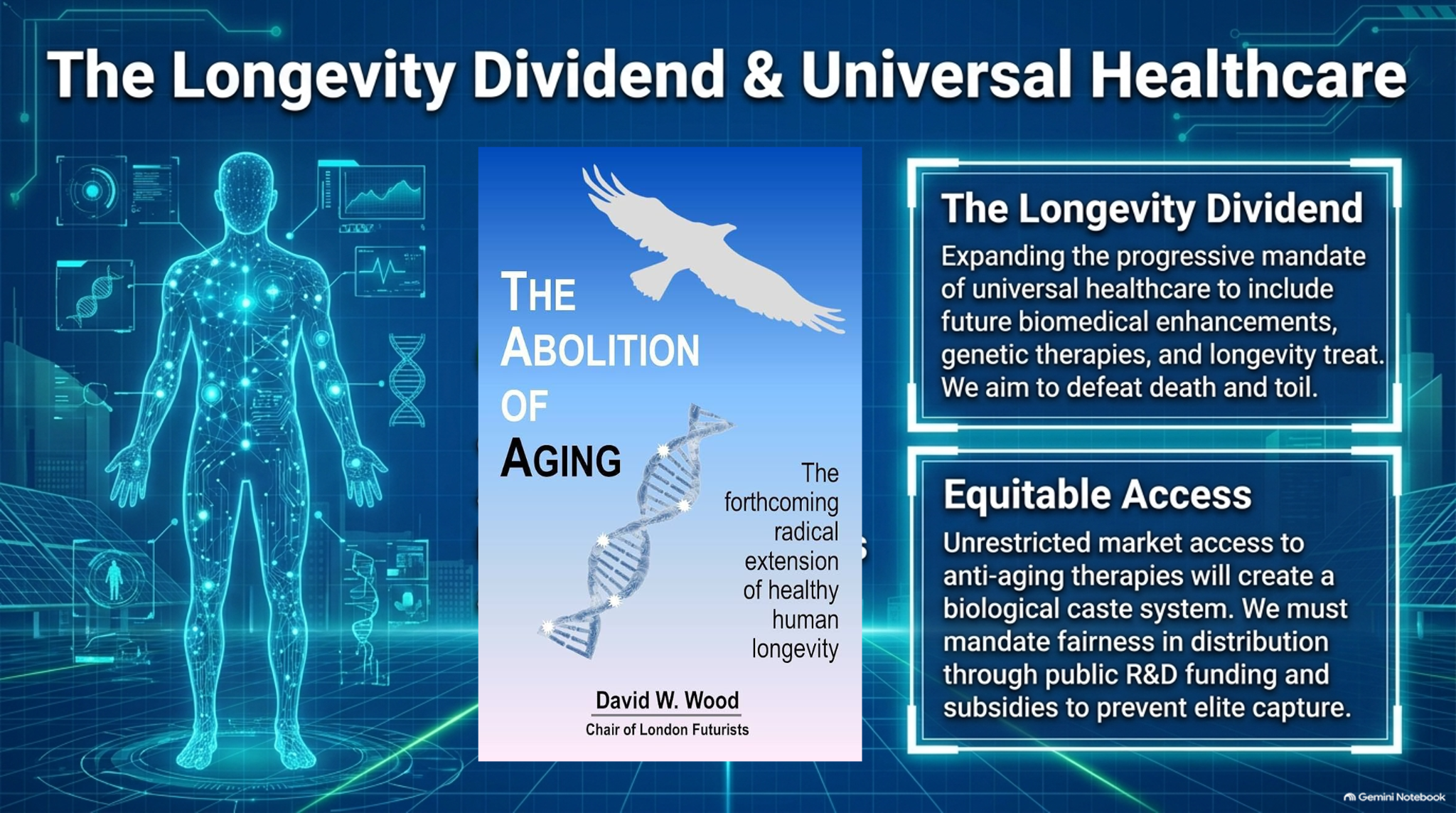
The Longevity Dividend & Universal Healthcare
Like the sewer socialists and public health progressives a century ago, technoprogressives extend social democracy to health and biology. Advancements in biotechnology, regenerative medicine, and prosthetics are demonstrating that biological aging can be medically targeted to extend healthy human lifespans.
Bioconservatives mock longevity research. They claim aging is natural. Meanwhile, biotech entrepreneurs and hucksters sell expensive therapies to the wealthy elite. Technoprogressives argue instead for a Longevity Dividend. By funding anti-aging research publicly and by integrating longevity treatments into universal healthcare systems, we can keep populations healthy, protect public welfare systems from demographic collapse, and prevent the nightmare of a biologically bifurcated society where only the rich live long, healthy lives.
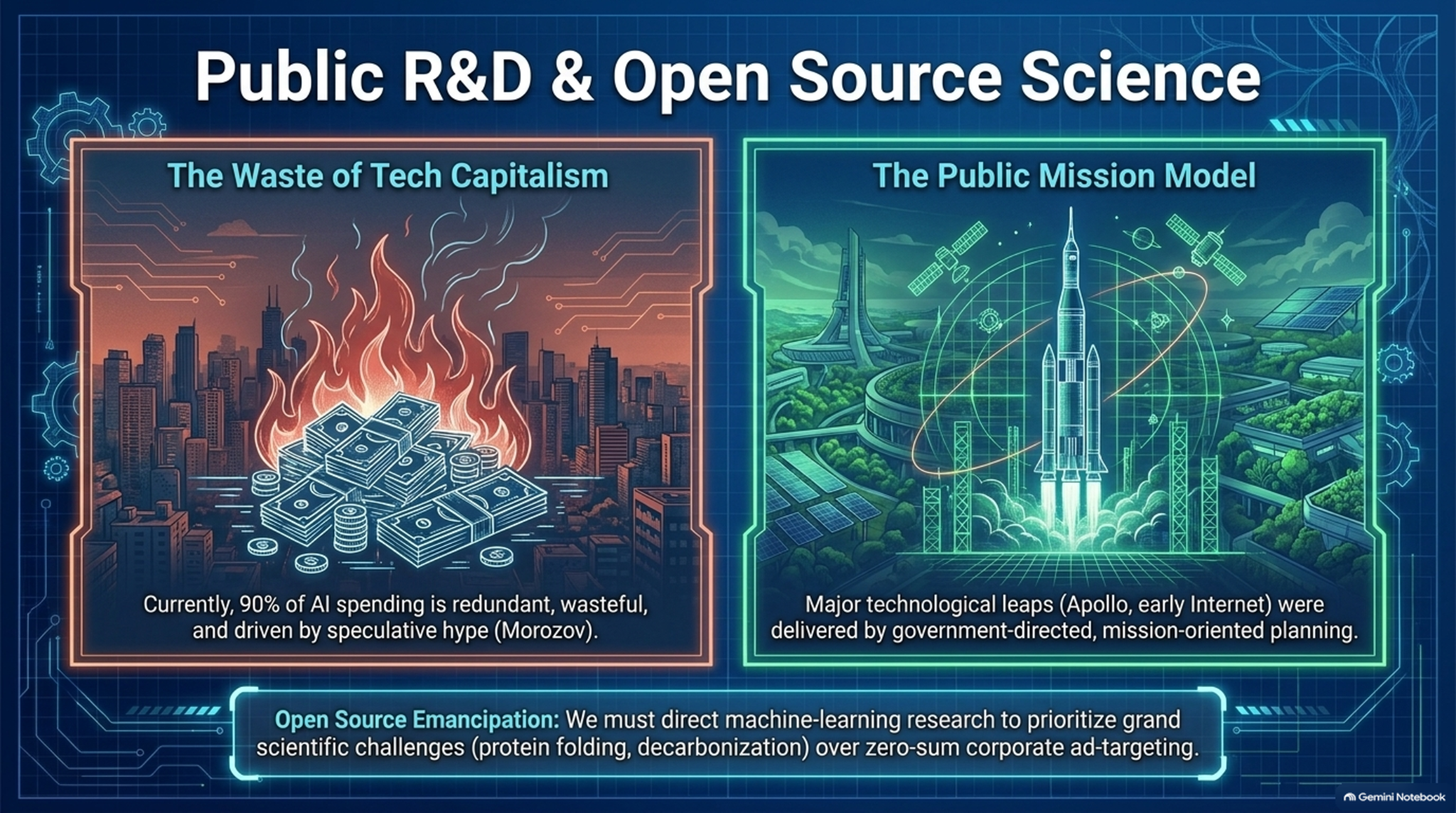
Public R&D & Open-Source Innovation
Where does innovation come from? Neoliberal dogma claims that private markets drive scientific breakthroughs. But history proves that almost every foundational technology—the internet, GPS, touchscreens, mRNA vaccines—was funded by public research dollars.
Private corporations lock publicly funded knowledge behind restrictive patents and corporate silos. They extract monopoly profits after we fund the initial research. Technoprogressives demand a revolution in public research and development, starting with AI safety, green energy, and longevity therapies.
We call for massive public investment in open-source science. Medical research, AI weights, and green tech patents funded by public money must remain in the public domain. By breaking down corporate silos and their enclosure of the commons, we can accelerate scientific discovery and ensure life-saving innovations are freely available to everyone.
Morphological Freedom & Bodily Autonomy
Technoprogressives defend our basic rights to control our own bodies, brains, and reproduction. But we need to update morphological freedom to account for emerging biomedical technologies. Assisted reproduction and genomic choices are part of reproductive freedom. Control over our sex/gender characteristics. Protection for neurodiversity and the ability to control our own brains with drugs and devices. Technoprogressives insist that our body and mind belong to us—not to religious authorities, patriarchal norms, or state bureaucrats—and that exercising that control means ensuring our access to technologies.
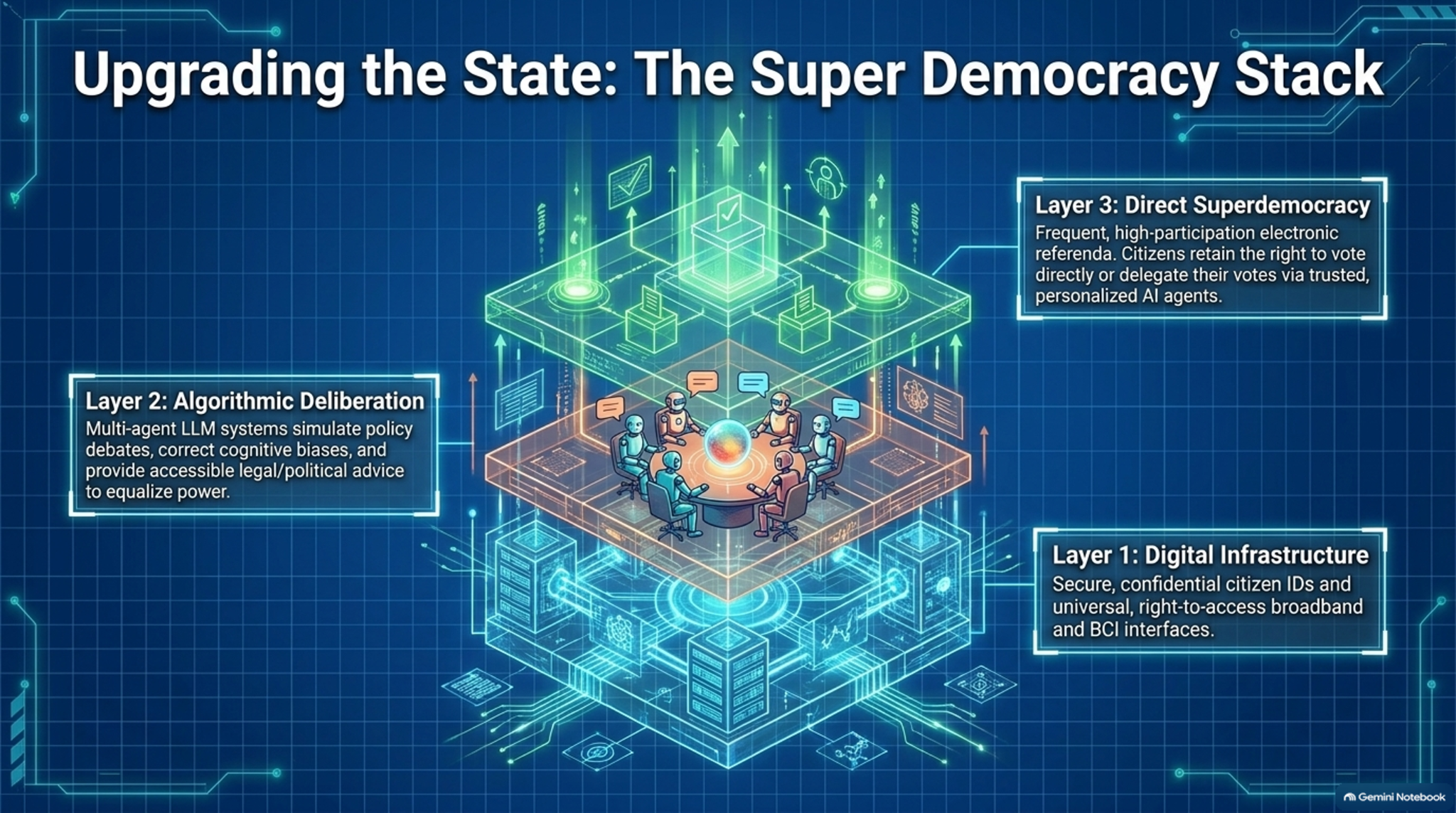
Super Democracy
How do we build the political power necessary to enact this ambitious vision? We advocate for Super Democracy—utilizing digital deliberative platforms, open-source participatory budgeting, and liquid democracy to transform passive voters into active, informed citizens. Every citizen can have an agentic model that monitors the world for relevant information, manages our participation in grassroots organizations, advocates our interests and views laterally and to the state, and advises on who we support with money and votes.
Since Hugging Face, we futurists have been like prophets talking to the religiously illiterate about signs of the End Times. But even the oligarchs are beginning to be spooked. Technoprogressives treat existential risks—nuclear war, unaligned artificial superintelligence, synthetic bioweapons, and climate tipping points—with absolute seriousness. Trump and MAGA killed the ailing “rules-based order,” and the multipolar world looks a lot more like 19th-century imperialism. Existential risk mitigation, however, requires strong, binding transnational governance, and the re-invigoration of the world federalist project. We advocate for international treaties regulating dangerous dual-use research, global compute monitoring, and coordinated climate engineering protocols.
We cannot leave the survival of the human species to the self-regulation of tech billionaires and great power competition. Global democratic oversight is the only force capable of steering powerful technologies away from catastrophic misuse.
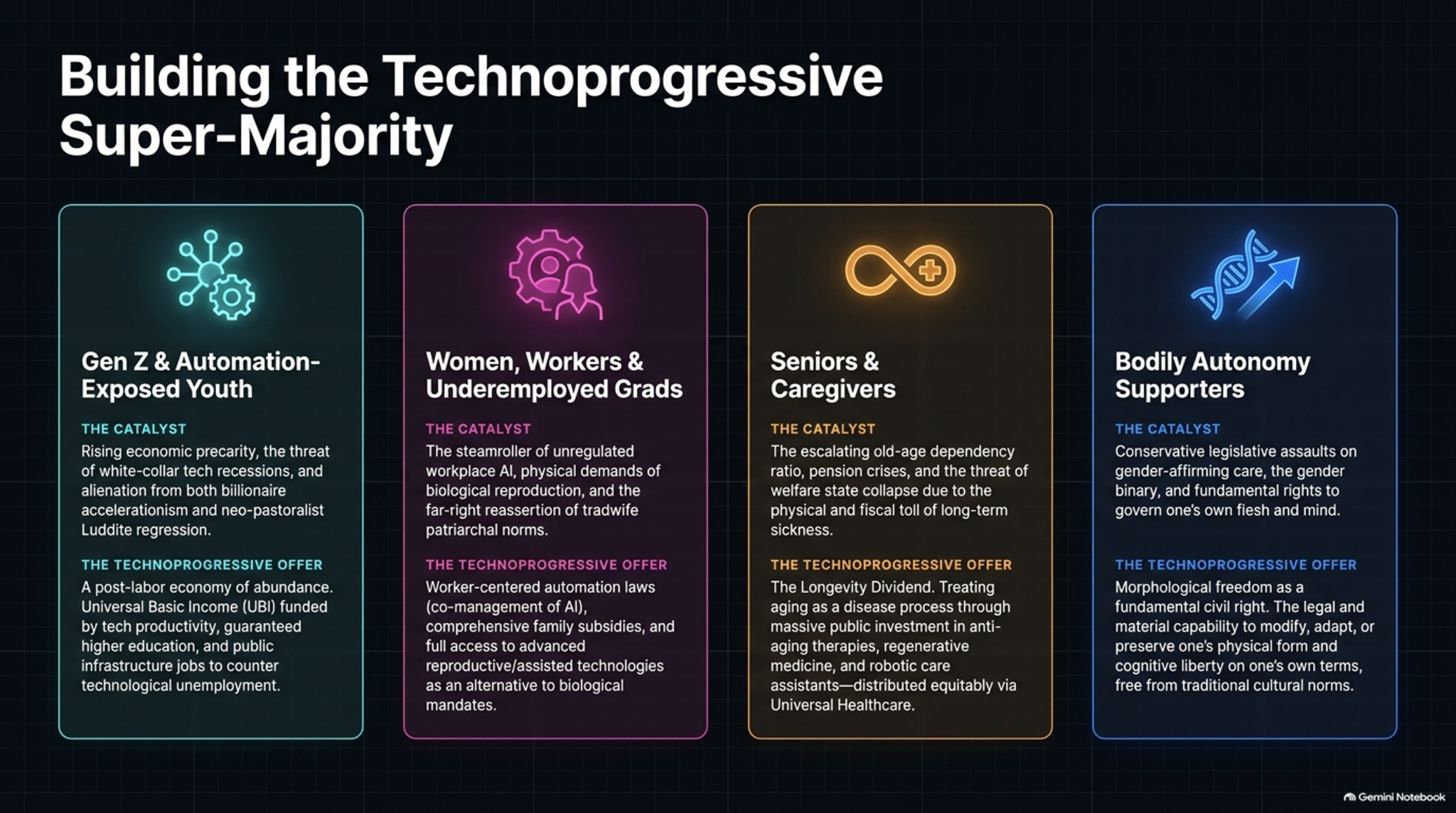
Building the Technoprogressive Majority
To become a political actor, technoprogressivism must anchor itself in the material struggles of a broader democratic coalition. Blue-collar and underemployed workers and women are much less techno-optimistic than college-educated workers and men, so keeping policies focused on workers and women is key to expanding our appeal.
Young people: Automation-exposed Gen Z and indebted, underemployed college graduates already confront acute precarity. They are a natural vanguard demanding a universal basic income. Most Gen Z in Europe and the US now support UBI.
Workers: Codetermination over workplace automation, and policies that ensure productivity gains enrich organized labor and build working-class power.
Women: The far right is pushing a return to tradwives and the patriarchal family. Technoprogressives instead propose family subsidies and equal access to assisted reproduction.
Seniors: Seniors gain directly from the Longevity Dividend, although we all do eventually, pairing therapies with public long-term care to conquer the demographic caregiving squeeze.
Sexual and gender minorities: Crucially, championing morphological self-determination contextualizes support for transgender rights within an expansive, universal civil liberty for all citizens.
By marrying technological empowerment to these social-democratic constituencies, and to the campaigns of drug law reformers, AI safety activists, and eco-realist climate change advocates, a technoprogressive coalition can build a new governing majority.
IEET Technoprogressive Policy Project
The IEET now has a base at the University of Turin, through which we have cooperation agreements with European universities and the Vatican college’s team working on AI ethics. The Turin Hub also manages our Journal of Ethics and Emerging Technologies and our book series.
In Boston, we have completed two multi-year projects on the future of work and brain-computer interfaces. We’ve now brought in three soldier-scholars for a two-year research program on building a conscience into autonomous military technology.
In 2025, we also launched the Technoprogressive Policy Project.
This summer Matteo and I taught a 10-week Technoprogressive Worldbuilding Course on the intellectual history and policy tools needed to conceptualize high-tech social democratic futures.
Currently, the IEET sponsors three podcasts, Technoprogressive Hub, Prosthetic Gods, and Bread and Robots, hosted by Matteo, all found on Substack. We also promote our community's public intellectual work, such as David Wood’s excellent London Futurists podcast and meetings. We are working on the fourth book in our De Gruyter series on the politics of human enhancement. We are also sponsoring the work of technoprogressive public intellectuals like David Shapiro, who works on post-labor economics.
We also sponsor conferences: In addition to this conference, the IEET just organized a conference on brain-computer interfaces in Boston in May, and we’re working on another conference next May on enhancement ethics in Montenegro. We also provide conference grants, most recently to African transhumanists meeting in December.
Our ultimate goal is to translate idea advocacy into direct legislative impact. To achieve this…
The TechnoProgressive Policy Handbook & Rubric: We are now collecting essays for a planned handbook on technoprogressive policy targeting about fifty policy domains, from the longevity dividend and rights for robots to existential risks and space policy. The rubric is designed as an explicit, democratic-left counter-manifesto to reactionary blueprints like the US Right’s Project 2025. Each chapter will provide progressive lawmakers with concrete, 3,000-word policy briefs spanning near-term administrative fixes, medium-term legislation, and longer-term aspirational goals. If you are interested in writing for this handbook, please let me know or contact Matteo, who will be the editor.
Creating a Dedicated TP Lobbying NGO: To ensure these briefs don’t just sit on academic shelves, we are actively exploring the formation of a dedicated technoprogressive lobbying and advocacy organization in Washington, DC, focused on influencing the Democratic Party from democratic socialists to abundance liberals. But we also want to build a policy agenda applicable worldwide.
Conclusion
Progress is not inevitable. Nor is dystopia. Yes, politics is baked into technological design, but it doesn’t determine who wins the next round. The future is an open terrain of political struggle, continuously disrupted by technological innovation. Let’s stop fearing the future. Let’s claim it, democratize it, and build a post-scarcity world of universal liberation together.
Thank you